Before Buying a Used Car or Bike, Check Vehicle Registration & RTO Details Online
Planning to buy a second-hand car or bike? Before making any payment, there is one important step that every buyer should complete: check the vehicle registration and RTO details online. A used vehicle may look attractive, offer excellent mileage, and come at an affordable price, but its registration history and legal documentation are equally important.
Many people purchase second-hand vehicles without properly checking their Registration Certificate (RC), insurance validity, pending traffic challans, or ownership transfer requirements. Such mistakes can create unexpected financial expenses and legal complications after purchasing the vehicle. Fortunately, digital vehicle verification services in India make it easier to review important registration information before finalising a deal.
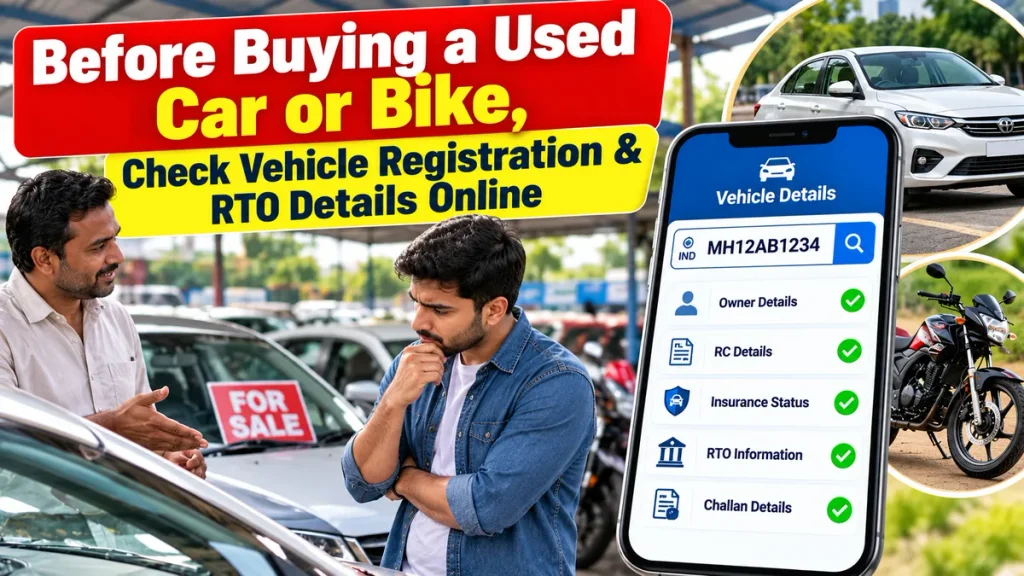
With a vehicle registration number, buyers can access certain vehicle details through authorised government services. Whether you are purchasing a used motorcycle, scooter, hatchback, sedan, or SUV, this guide explains how to check available vehicle information, verify RC details, understand RTO records, and complete a safer second-hand vehicle purchase.
Why Check Vehicle Registration Before Buying a Used Vehicle?
Buying a pre-owned vehicle can be a smart financial decision. Used cars and bikes are often more affordable than new models, and buyers may find suitable vehicles within their budgets.
However, the vehicle’s legal and registration history deserves careful attention.
Checking vehicle registration details helps buyers identify discrepancies between the seller’s documents and available government records.
Important benefits include:
- Registration verification: Confirm that the registration number matches the vehicle documents.
- RC status check: Review available Registration Certificate information.
- Insurance verification: Check recorded insurance validity before purchase.
- RTO identification: Find the registering Regional Transport Office.
- Vehicle information: Compare available make, model, vehicle class, and fuel details.
- Ownership transfer planning: Understand the documentation required after purchasing.
- Reduced purchasing risk: Identify warning signs that need further investigation.
Online verification does not guarantee a vehicle is free from every legal or mechanical problem, but it provides an important first level of protection.
How to Check Vehicle Registration Details Online
The Ministry of Road Transport and Highways provides vehicle-related digital services through the Parivahan and VAHAN platforms.
The official Know Your Vehicle Details facility allows users to search for basic information associated with a vehicle registration number.
Parivahan
+1
Step-by-Step Vehicle Registration Check
Step 1: Open the Official Parivahan Portal
Visit the official Parivahan vehicle services platform using your mobile phone or computer.
Step 2: Find Know Your Vehicle Details
Choose the section that provides vehicle registration information.
Step 3: Complete Login or Verification
Some services require mobile-number authentication, OTP verification, or other security checks.
Step 4: Enter the Vehicle Registration Number
Carefully enter the number printed on the vehicle’s registration plate.
For example, a registration number may follow a format similar to WB02AB1234 or DL01CD5678.
Step 5: Submit the Information
Complete the required verification and request the available vehicle record.
Step 6: Examine the Displayed Details
Review the information shown, such as registration date, vehicle category, registering authority, and available document validity details.
Step 7: Compare Records With Seller Documents
Ensure the displayed vehicle information is consistent with the RC and other documents provided by the seller.
If you notice a mismatch, request clarification before proceeding with the purchase.
What Vehicle Information Can You Check Online?
Different vehicle records and services may display different information. Some sensitive details are restricted to protect personal privacy.
The following table summarises information commonly relevant when checking a second-hand vehicle.
| Vehicle Detail | Information to Verify | Importance |
|---|---|---|
| Registration Number | Registered vehicle number | Confirms basic identity |
| Registration Date | Original registration date | Helps determine vehicle age |
| RTO Information | Registering authority | Identifies registration location |
| Vehicle Make & Model | Manufacturer and model details | Detects document mismatches |
| Fuel Type | Petrol, diesel, CNG, electric | Confirms vehicle specifications |
| RC Validity | Registration validity, if available | Supports legal compliance |
| Insurance Status | Recorded insurance validity | Identifies renewal needs |
| PUC Status | Pollution certificate validity | Helps check compliance |
| Fitness Validity | Fitness details where applicable | Relevant for eligible vehicles |
| Hypothecation | Finance interest, if available | Helps identify loan-related concerns |
Not every detail is accessible through a public registration search. Certain information may require owner authentication, documentary verification, or an enquiry with the relevant authority.
How to Verify RC Details Before Buying a Used Car or Bike
A Registration Certificate is one of the most important documents associated with any registered motor vehicle.
It provides official information about the vehicle and its registration.
Before buying a used vehicle, ask the seller to provide the RC for inspection.
Important RC Information to Examine
1. Vehicle Registration Number
The number displayed on the RC should match the vehicle’s registration plate.
2. Vehicle Make and Model
Check whether the manufacturer and vehicle description match the actual car or bike.
3. Registration Date
This helps establish the vehicle’s registered age and allows comparison with the seller’s claims.
4. Chassis Number
Physically inspect the chassis or vehicle identification number at its manufacturer-designated location. Compare it with the RC and other authentic documents.
5. Engine Number
Where applicable, verify the engine number against the registration records.
6. Registration Validity
Confirm that the registration remains valid and determine whether renewal or other formalities are necessary.
Discrepancies involving chassis numbers, engine numbers, or registration identity should be resolved before payment.
Check Used Vehicle Insurance Status Online
Insurance verification is another essential part of buying a second-hand vehicle.
In India, valid third-party motor insurance is generally required for vehicles used on public roads.
Before purchasing, ask the seller for the insurance policy document and confirm its validity directly with the insurer when necessary.
You can also review recorded insurance validity through supported vehicle-information services.
What Should You Verify?
- Whether the policy is currently active.
- The insurance expiry date.
- The vehicle registration number mentioned in the policy.
- Whether the policy provides third-party or comprehensive coverage.
- Whether the policy requires transfer or endorsement following the sale.
If insurance has already expired, clarify renewal requirements before taking the vehicle onto public roads.
Remember that vehicle registration databases can sometimes display outdated insurance information. The insurer’s authentic policy record should be checked if there is a discrepancy.
How to Check Pending Traffic Challans Before Purchase
An unpaid traffic challan is another important issue to investigate before buying a used vehicle.
Traffic violations may be associated with the vehicle registration number, and unresolved challans can complicate the purchase or subsequent administrative procedures.
The government’s eChallan services provide facilities for checking eligible traffic challan information.
Steps to Check Pending Challans
- Open the official eChallan service.
- Locate the challan-status facility.
- Enter the vehicle registration number or other required information.
- Complete the verification process.
- Review any available pending challans.
- Discuss unresolved liabilities with the seller before finalising payment.
Not all traffic enforcement records are necessarily available in one system. State-specific services or direct verification may sometimes be needed.
A clean online challan search should therefore be treated as useful evidence, not an absolute guarantee.
Understanding Vehicle Hypothecation and Loan Status
Many cars and bikes are purchased using vehicle finance or bank loans.
When a vehicle is financed, the Registration Certificate may contain a hypothecation entry showing the financial institution’s interest.
Before buying a financed or previously financed vehicle, buyers should verify whether the loan has been fully settled and whether the relevant registration records have been updated.
Ask the seller for suitable loan-closure documents and confirmation that the financier’s interest has been removed where required.
If hypothecation remains active, the ownership transfer may require additional documentation or consent.
Do not rely only on the seller’s verbal assurance that the loan has been paid.
Important Documents to Check Before Buying a Second-Hand Vehicle
A responsible second-hand vehicle purchase involves more than checking the registration number.
| Required Document | Why You Should Check It |
|---|---|
| Registration Certificate (RC) | Confirms registration identity |
| Insurance Certificate | Establishes insurance details |
| Pollution Under Control Certificate | Shows recorded emission compliance |
| Seller Identity Documents | Helps verify the seller’s authority |
| Form 29 | Used for notice of ownership transfer |
| Form 30 | Used for reporting/applying for ownership transfer |
| Loan Closure / NOC Documents | Relevant for financed vehicles |
| Service History | Helps understand maintenance |
| Purchase Agreement | Records sale terms and responsibilities |
| Road Tax Records | Helps identify tax-related issues |
The actual documents required for transfer can vary based on state rules and the vehicle’s circumstances.
How to Transfer Ownership After Buying a Used Vehicle
Completing the ownership transfer is essential after purchasing a pre-owned car or bike.
The official ownership transfer process generally uses Form 29 and Form 30.
Under the published Parivahan guidelines, the buyer’s transfer application generally has a 14-day timeframe for vehicles registered within the same state and a 45-day timeframe for vehicles registered outside the state. Additional documentation can apply to interstate transactions.
MParivahan
+1
General Ownership Transfer Process
Step 1: Prepare the purchase agreement and required vehicle documents.
Step 2: Ensure the seller completes the necessary transfer notification or initiation requirements.
Step 3: Access the appropriate VAHAN citizen service or registering authority.
Step 4: Enter the vehicle details and select the applicable ownership transfer service.
Step 5: Complete the required application forms and document submission.
Step 6: Pay the applicable government fees and taxes.
Step 7: Complete any required RTO verification or appointment.
Step 8: Track the application and confirm that the updated RC reflects the buyer’s ownership.
Insurance transfer and other policy endorsements should also be completed according to applicable requirements.
Used Car vs Used Bike – What Should You Check?
Both second-hand cars and motorcycles require registration verification, but their practical inspection requirements differ.
| Inspection Area | Used Car | Used Bike |
|---|---|---|
| RC Verification | Essential | Essential |
| Insurance Validity | Essential | Essential |
| Chassis Number | Verify carefully | Verify carefully |
| Engine Condition | Detailed inspection | Engine inspection |
| Service History | Important | Important |
| Tyres and Brakes | Inspect all wheels and braking system | Inspect tyres and braking system |
| Accident Damage | Check body and structural repairs | Check frame and structural damage |
| Test Drive | Recommended | Recommended |
| Ownership Transfer | Required | Required |
A qualified mechanic’s inspection is especially valuable because online registration records cannot reveal every mechanical defect.
Common Mistakes to Avoid When Buying Used Vehicles
Second-hand buyers sometimes focus primarily on price, mileage, or appearance.
However, ignoring documentation can turn an apparently affordable purchase into an expensive problem.
Avoid paying the entire amount before verifying the vehicle identity and seller’s authority.
Never purchase a vehicle when its chassis number appears altered or cannot be matched with authentic documentation.
Do not assume that insurance automatically transfers with every benefit unchanged after the sale.
Also avoid leaving ownership transfer incomplete simply because the seller has provided a signed agreement.
Finally, be cautious of suspiciously low prices and sellers who refuse reasonable document verification.
Frequently Asked Questions (FAQs)
1. Can I check a used vehicle’s registration details using its number plate?
Yes. Available basic registration information can be checked through authorised vehicle-information services using a valid registration number.
2. How can I check RC details online before buying a bike?
Use the official vehicle information service, enter the registration number, and review the available registration details. Compare them with the seller’s RC.
3. Is it possible to identify the full vehicle owner using the registration number?
Public services generally restrict sensitive personal information. Full owner details are not necessarily available through an ordinary public search.
4. Can I check used car insurance validity online?
Yes. Recorded insurance validity may be available through supported transport services. You should also verify the actual policy with the insurer.
5. Why should I check pending challans before purchasing?
Outstanding traffic challans can create financial or administrative complications. Verifying them helps buyers negotiate and resolve responsibilities before the sale.
6. How do I know whether a used vehicle has an outstanding loan?
Check available hypothecation information and request authentic loan-closure or financier documents from the seller.
7. Can I transfer ownership of a second-hand vehicle online?
Many ownership-transfer procedures can be initiated through VAHAN services, although document verification or an RTO visit may still be required.
8. Which forms are generally required for a normal ownership transfer?
Form 29 and Form 30 are generally used, along with relevant supporting documents.
9. Can I buy a used vehicle with expired insurance?
A sale may still be possible, but the buyer must arrange legally required coverage before using the vehicle on public roads.
10. Is online vehicle verification completely reliable?
Official vehicle databases are valuable, but records may be incomplete or delayed. Buyers should also verify physical documents, vehicle identity, finances, and mechanical condition.
Conclusion
Buying a second-hand car or bike can help you save money, but checking its registration and RTO information before purchase is a crucial precaution.
Using authorised vehicle-information services, buyers can examine available RC details, registration dates, insurance validity, and related vehicle records. Additional checks for pending traffic challans, hypothecation, ownership documents, and mechanical condition can significantly improve the buying decision.
A reliable used-vehicle purchase involves matching digital records with authentic documents, inspecting the actual vehicle, and completing the required ownership transfer.
Before paying for any used car or bike, verify its registration number, check available RTO details, confirm insurance and finance records, and carefully review the seller’s documents. These simple precautions can help make your second-hand vehicle purchase safer, more transparent, and financially responsible.