Is There a Pending Challan on Your Vehicle? Check Traffic Fines & RTO Details Online
Have you ever wondered whether your car or bike has an unpaid traffic challan? Many vehicle owners in India receive traffic fines without immediately realising that a violation has been recorded against their vehicle. Whether it involves overspeeding, riding without a helmet, jumping a red light, or violating other traffic regulations, an unpaid challan can become an unexpected problem.
With the introduction of digital traffic enforcement systems, checking pending challans online has become much more convenient. Vehicle owners can use government-supported eChallan services to review available traffic fine details using their vehicle registration number, challan number, or driving licence information. This means you can check many traffic violations without visiting a traffic police office.
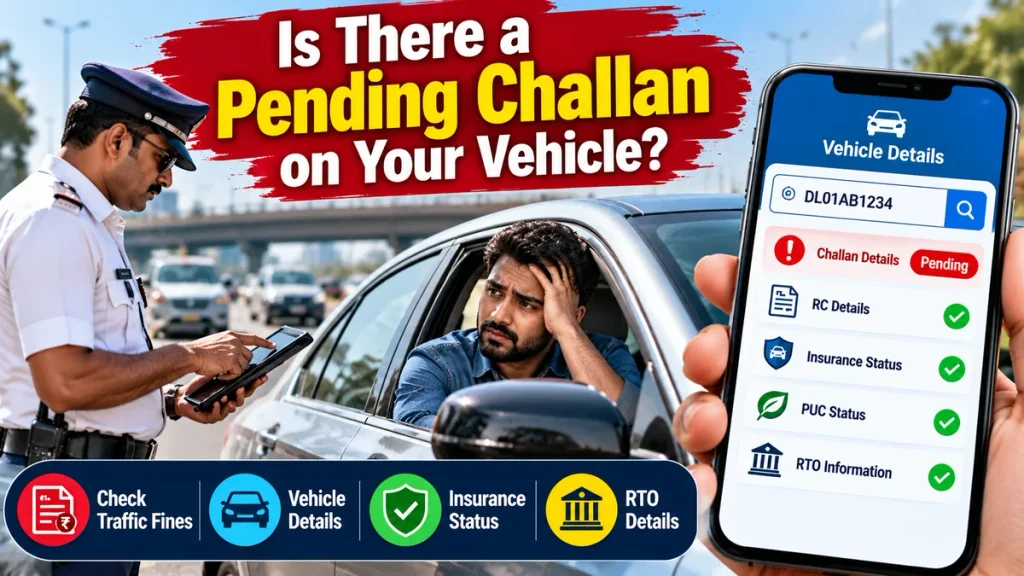
Regularly checking your vehicle’s challan status helps you understand outstanding fines, verify traffic violations, and maintain important vehicle records. In this guide, you will learn how to check pending challans online, view traffic fine details, verify RC and RTO information, and complete online challan payments safely.
What Is an eChallan and Why Is It Important?
An eChallan is an electronic traffic violation notice issued by an authorised traffic enforcement agency. It is part of India’s digital traffic enforcement system, which helps authorities record, process, and manage traffic violations.
Traffic challans may be issued by traffic police officers or through authorised electronic enforcement systems, including cameras and other monitoring equipment.
When a violation is recorded, an electronic challan may contain information about the vehicle, location, offence, applicable penalty, and payment status.
Benefits of Checking eChallan Status Online
- Identify pending traffic fines: Discover unpaid challans recorded against your vehicle.
- Review violation details: Check the type of offence, date, and available location information.
- Avoid payment confusion: Verify whether a challan has already been paid.
- Access digital payment options: Pay eligible challans through authorised services.
- Support used-vehicle verification: Review available traffic violations before purchasing a second-hand car or bike.
- Maintain vehicle records: Identify challan-related issues before certain vehicle transactions.
Checking your challan status periodically is a useful habit for responsible vehicle ownership.
How to Check Pending Challan on Vehicle Number Online
The Ministry of Road Transport and Highways provides an official eChallan service for checking traffic fine information.
The portal supports searches using details such as challan number, vehicle registration number, and driving licence number, although the required verification may vary.
Parivahan Sewa
+1
Step-by-Step Guide to Check Traffic Challan Status
Step 1: Open the Official eChallan Portal
Visit the official government eChallan service from your mobile phone or computer.
Step 2: Select Check Challan Status
Find the option that allows you to search for an existing traffic challan.
Step 3: Choose Your Search Method
Depending on the available facility, select one of the following:
- Vehicle registration number
- Challan number
- Driving licence number
Step 4: Enter the Required Details
Carefully enter the requested information. Additional information, such as registration date or date of birth, may be required.
Step 5: Complete Security Verification
Enter the displayed captcha or complete any other required verification.
Step 6: View Pending Challan Information
The portal may show details such as the challan number, offence date, fine amount, department, and payment status.
Step 7: Review the Fine Carefully
Check whether the challan corresponds to your vehicle and whether the offence details appear accurate.
If a payment option is available, follow the official instructions to complete the transaction.
What Details Can You Check in an Online Traffic Challan?
The information available depends on the issuing authority and the underlying traffic enforcement records.
| Challan Information | Details Available | Why It Matters |
|---|---|---|
| Challan Number | Unique challan reference | Helps identify the notice |
| Vehicle Number | Registered vehicle number | Confirms vehicle association |
| Violation Date | Date of recorded offence | Helps identify the incident |
| Challan Amount | Applicable traffic fine | Shows payment amount |
| Offence Type | Nature of traffic violation | Explains the penalty |
| Issuing Department | Traffic or transport authority | Identifies the issuing agency |
| Challan Location | Location, when recorded | Helps verify the incident |
| Payment Status | Pending, paid, or other status | Shows available payment information |
| Offence Details | Applicable violation information | Helps review the challan |
Some records may be incomplete, delayed, or available through separate state traffic police systems.
Common Traffic Violations That Can Result in Challans
Traffic rules are intended to improve road safety and reduce dangerous driving behaviour.
Different violations carry different penalties, and the applicable amount may depend on the Motor Vehicles Act, state notifications, and the circumstances of the offence.
1. Riding Without a Helmet
Motorcycle riders and pillion passengers must follow applicable helmet requirements. Violations may result in penalties.
2. Driving Without a Seat Belt
Failing to wear a required seat belt can lead to a traffic challan.
3. Overspeeding
Driving beyond the applicable speed limit may result in fines and other enforcement action.
4. Jumping Traffic Signals
Ignoring traffic lights can lead to challans and create serious accident risks.
5. Driving Without Required Insurance
Using a vehicle without legally required third-party insurance can lead to penalties.
6. Driving Without a Valid Licence
Operating a vehicle without a valid licence for the relevant vehicle category can result in legal consequences.
7. Using a Mobile Phone While Driving
Prohibited mobile phone use while driving can lead to enforcement action.
8. Driving Under the Influence
Drunk driving is a serious offence that may involve court proceedings and additional legal consequences.
Not every traffic offence can be settled simply by paying an online fine.
Traffic Fine Categories in India – Quick Overview
The table below explains common violation categories without assuming one fixed penalty applies across every state.
| Traffic Violation | Possible Consequences |
|---|---|
| Riding Without Helmet | Fine and other applicable action |
| Driving Without Seat Belt | Monetary penalty |
| Overspeeding | Fine based on applicable provisions |
| Red Light Violation | Traffic penalty |
| No Valid Driving Licence | Fine and potential legal proceedings |
| No Mandatory Insurance | Fine and possible further legal consequences |
| Dangerous Driving | Fine, prosecution, or other action |
| Drunk Driving | Serious penalties and potential court proceedings |
| Vehicle Document Violations | Fine depending on the offence |
Important: Always confirm the amount shown on the official challan. Fines can differ according to applicable legal provisions, state implementation, offence history, and the individual case.
How to Pay Pending Traffic Challan Online
After checking your pending challan details, you may be able to pay the fine digitally through an authorised government payment facility.
Online Challan Payment Process
Step 1: Access the official eChallan service.
Step 2: Search for the challan using the relevant details.
Step 3: Check the challan number, vehicle number, offence description, and payable amount.
Step 4: Select the payment option if the challan is eligible for online settlement.
Step 5: Choose an available authorised payment method.
Step 6: Complete the payment securely.
Step 7: Save the transaction reference and payment receipt.
Step 8: Verify that the payment status updates successfully.
The official portal includes facilities for checking payment transactions and obtaining receipts for eligible successfully paid challans.
Parivahan Sewa
+1
If your payment is deducted but the challan still appears unpaid, first verify the transaction status before attempting another payment.
Check Vehicle RC and RTO Details Online
Apart from traffic fines, vehicle owners should also regularly verify important Registration Certificate and RTO details.
Your Registration Certificate contains information about your vehicle’s official registration.
The VAHAN vehicle services platform provides facilities for checking available registration information.
Vehicle Details Worth Checking
- Vehicle registration number
- Registration date
- Vehicle make and model
- Registering RTO
- Vehicle class and fuel type
- Registration validity
- Available insurance validity
- Pollution certificate information
- Fitness certificate validity, where applicable
Some information is restricted, and accessing complete records may require authentication.
Checking these details can be particularly useful when purchasing a second-hand vehicle or reviewing important documents before a long journey.
Can Pending Challans Affect Vehicle Ownership Transfer?
If you are planning to sell your car or bike, checking for pending traffic challans before the transaction is a sensible precaution.
Unresolved fines may create administrative difficulties or disputes between buyers and sellers.
Before finalising a second-hand vehicle purchase, review available challan information and ask the seller to resolve outstanding liabilities.
It is also important to verify registration records, insurance status, loan hypothecation, and ownership transfer documentation.
A clean challan record does not guarantee that a vehicle has no other legal or financial issues.
What Happens If You Do Not Pay a Traffic Challan?
Ignoring a valid traffic challan can create complications.
Depending on the issuing authority, offence, and legal procedure, an unresolved challan may lead to reminders, additional enforcement steps, or court-related proceedings.
Some matters may require a hearing rather than ordinary online payment.
Vehicle owners should check the applicable notice and follow the instructions issued by the authorised authority.
If you disagree with a challan, use the available grievance or legal challenge procedure instead of ignoring the notice.
How to Identify Fake Traffic Challan Messages
Fraudulent traffic challan messages are a growing digital safety concern. Scammers may send SMS messages, messaging-app notifications, or fake payment links that resemble government notices.
The official eChallan service specifically warns users about impersonating websites and applications.
Parivahan Sewa
Tips to Avoid eChallan Fraud
- Access the government portal by entering the official address yourself.
- Avoid clicking suspicious payment links in unexpected messages.
- Never disclose OTPs, passwords, or sensitive banking information to callers.
- Verify the challan number through the authorised service.
- Check the payment destination before completing a transaction.
- Do not install unknown APK files claiming to provide challan payment services.
- Report suspected fraud to the appropriate cybercrime or police authority.
A legitimate challan should be verified through official channels before any payment is made.
Why Is My Challan Not Showing Online?
Sometimes, a traffic challan may not appear immediately after a violation.
Possible explanations include delayed data updates, incorrect search details, unavailable state records, or temporary technical problems.
If you received a notice but cannot find the challan, confirm the registration number and search using the challan reference.
You can also check the appropriate state traffic police service or contact the issuing authority.
Do not assume that a missing search result automatically cancels a valid challan.
Frequently Asked Questions (FAQs)
1. How can I check pending challans using my vehicle number?
Open the official eChallan service, select the vehicle-number search option, enter the requested details, and complete verification to view available challan records.
2. Can I check bike challan status online?
Yes. Available motorcycle and scooter challans can be searched using supported government traffic enforcement services.
3. Is a vehicle registration number enough to check traffic fines?
It can be used to initiate a search, although additional verification details may be required.
4. Can I pay my car challan online?
Many eligible challans support online payment. Some offences or cases may require a different settlement procedure.
5. How do I check whether my challan payment was successful?
Use the payment or transaction-status service and retain the transaction reference or payment receipt.
6. Can I check RTO and RC details with my vehicle number?
Yes. Authorised vehicle information services provide access to available registration details, subject to security and privacy restrictions.
7. What should I do if a challan was issued incorrectly?
Use the grievance process provided by the relevant traffic authority or follow the applicable legal challenge procedure.
8. Do all Indian states use the same eChallan system?
No. Integration and available services can vary by state and enforcement authority. Some records may need to be checked using state-specific systems.
9. Can a traffic challan lead to court proceedings?
Yes. Certain offences or unresolved cases can require legal proceedings depending on applicable rules and the circumstances.
10. Is it safe to pay traffic challans through mobile phones?
Yes, when you use an authentic authorised payment service and follow appropriate digital payment security precautions.
Conclusion
Checking for pending traffic challans is an important part of responsible vehicle ownership in India. Whether you drive a car, motorcycle, or scooter, regularly reviewing your traffic fine status can help you identify outstanding penalties, verify recorded violations, and resolve payment-related concerns.
Official eChallan services make it possible to review available traffic fine information without visiting a traffic police office for every enquiry. Vehicle owners can also use authorised transport services to check important RC, insurance, and RTO registration details.
Before your next journey, check whether your vehicle has a pending challan, verify the fine details, and resolve genuine outstanding notices through authorised channels. Regular document verification and safe driving habits can help you avoid unnecessary complications and maintain better control over your vehicle records.