Want to Drive Legally in India? Know How to Apply for Your Driving Licence Online
Driving a car or motorcycle is an exciting experience, but having a valid driving licence is essential before using public roads in India. Whether you are a first-time driver, a college student, or someone planning to purchase a new vehicle, understanding the driving licence online application process can help you get started confidently.
Many people believe applying for a driving licence requires complicated paperwork and repeated visits to the Regional Transport Office (RTO). However, India’s digital transport services now allow applicants to complete several important procedures online, including application submission, fee payments, appointment booking, and application status tracking.
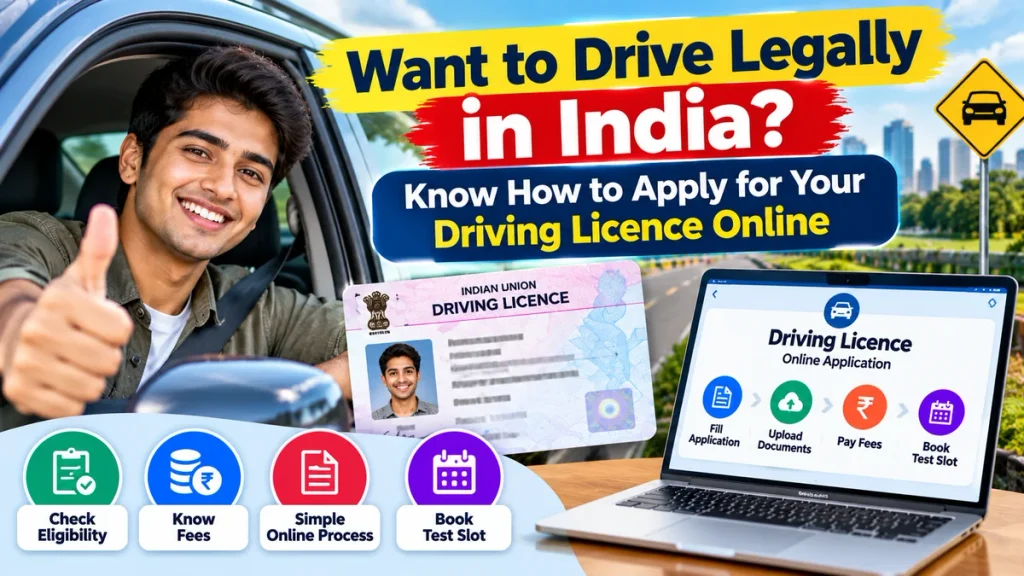
If you want to apply for a driving licence online in India, this detailed guide explains eligibility criteria, minimum age requirements, necessary documents, application fees, learner’s licence procedures, and permanent licence requirements.
Why Is a Driving Licence Important in India?
A driving licence is an official authorisation issued by a competent licensing authority. It permits an eligible individual to operate specified categories of motor vehicles on public roads.
Driving without a valid licence can result in penalties under the Motor Vehicles Act. It may also create complications involving vehicle insurance and legal responsibility following an accident.
Holding an appropriate driving licence demonstrates that you have completed the required licensing procedures and satisfied applicable driving competency requirements.
Applicants should ensure that their licence covers the vehicle category they intend to drive.
Types of Driving Licences Available in India
Different driving licence categories are available depending on the vehicle and intended use.
| Licence Type | Description |
|---|---|
| Learner’s Licence | Allows driving practice under prescribed conditions |
| Permanent Driving Licence | Authorises driving after successful qualification |
| Motorcycle Licence | Covers specified categories of two-wheelers |
| Light Motor Vehicle Licence | Covers eligible cars and light vehicles |
| Transport Vehicle Authorisation | Applies to relevant commercial vehicle categories |
| International Driving Permit | Facilitates driving abroad subject to applicable rules |
For most first-time applicants, obtaining a learner’s licence is the first important step.
Driving Licence Eligibility Criteria
Before submitting an application, individuals must satisfy the prescribed age and other eligibility requirements.
Minimum Age Requirements
16 Years: Applicants may qualify for limited categories of motorcycles without gear, not exceeding 50cc, subject to guardian consent and legal conditions.
18 Years: Applicants can generally apply for licences covering private cars and eligible motorcycles.
20 Years: This is the general minimum age for transport vehicle licensing, subject to additional requirements.
Applicants must also satisfy applicable medical fitness and driving knowledge requirements.
Parivahan
Documents Required for Driving Licence Application
Applicants should prepare the necessary documents before beginning the online process.
Common requirements include:
- Proof of age, such as a birth certificate or accepted educational certificate.
- Proof of residential address.
- Aadhaar card, where accepted and applicable.
- Recent passport-size photographs, if requested.
- Learner’s licence details for permanent licence applications.
- Medical declaration or certificate where required.
- Mobile number for communication and application updates.
Additional documents may be requested depending on the applicant’s state, age, and vehicle category.
Driving Licence Application Fees in India
Understanding government fees helps applicants prepare for the licensing process and avoid unnecessary expenses.
The standard central fee schedule includes the following charges.
| Driving Licence Service | Standard Fee |
|---|---|
| Learner’s Licence Issue | ₹150 per vehicle class |
| Learner’s Licence Test | ₹50 |
| Driving Competence Test | ₹300 per vehicle class |
| Permanent Driving Licence Issue | ₹200 |
| Driving Licence Renewal | ₹200 |
| International Driving Permit | ₹1,000 |
| Additional Vehicle Class | ₹500 |
These amounts represent standard prescribed fees. Additional state charges, service charges, or applicable fees may affect the final payable amount.
Parivahan
Applicants should verify the total displayed during online payment.
How to Apply for a Driving Licence Online in India
The Sarathi Parivahan platform offers digital services for driving licence applications across participating states.
Follow these steps to begin the process.
Step 1: Open the Sarathi Parivahan Portal
Visit the official Sarathi Parivahan platform using a smartphone, tablet, or computer.
Choose your state from the available list to access relevant transport services.
Step 2: Select the Appropriate Licence Application
First-time applicants generally need to select the new learner’s licence application option.
If you already possess a valid learner’s licence, choose the new driving licence application service.
Step 3: Complete the Application Form
Enter your personal information, including your full name, date of birth, address, and contact details.
Select the correct vehicle category carefully.
Step 4: Submit Necessary Documents
Upload the requested documents where this facility is available.
Ensure that uploaded images are clear and match the information provided in your application.
Step 5: Complete Fee Payment
Pay the prescribed application charges through the available payment methods.
Keep your payment receipt and application reference number safely.
Step 6: Book Your Appointment
Where required, select an available appointment for document verification or testing.
Attend the designated location with original documents.
Step 7: Complete the Required Assessment
Learner’s licence applicants must satisfy the applicable traffic knowledge assessment.
Permanent licence applicants must demonstrate practical driving competence.
These procedures may vary between states.
Parivahan
+1
How to Get a Learner’s Licence
A learner’s licence is designed for individuals beginning their driving journey.
Applicants are generally tested on basic traffic rules, road signs, road safety awareness, and responsible driving practices.
Some states provide online learner’s licence testing facilities, while others require applicants to attend an authorised centre.
A learner’s licence is generally valid for six months.
During this period, learners must follow prescribed restrictions and practise responsibly before attempting the permanent driving test.
How to Obtain a Permanent Driving Licence
After holding a valid learner’s licence for at least 30 days, applicants can generally become eligible to attempt the permanent driving test.
Applicants must schedule their test according to the procedures available through their state transport authority.
During the practical assessment, driving skills such as vehicle control, observation, manoeuvring, and compliance with road rules may be evaluated.
Successful applicants receive their driving licence after the applicable approval and issuance procedures.
Parivahan
How to Check Driving Licence Application Status
Applicants can conveniently monitor the progress of their applications through the online application status facility.
Select the relevant state and enter the requested application details.
The displayed information may indicate whether an application is pending, under verification, approved, or awaiting another required step.
Application processing timelines depend on local transport office procedures and individual circumstances.
Common Mistakes to Avoid During Application
Many application delays happen because of incorrect or incomplete information.
To reduce possible problems, applicants should:
- Verify their name and date of birth.
- Choose the appropriate vehicle class.
- Upload readable documents.
- Pay fees through authorised channels.
- Keep application reference details secure.
- Attend appointments on the scheduled date.
- Practise driving before the competency test.
Applicants should avoid individuals promising guaranteed driving licence approval without the required assessment.
Benefits of Applying for a Driving Licence Online
Online driving licence services provide several practical advantages.
Applicants can begin their registration process from home, review service information, make digital payments, and access available appointment facilities.
Online application tracking also reduces uncertainty about the progress of submitted requests.
However, digital application submission does not eliminate mandatory testing, verification, or other legal requirements.
Frequently Asked Questions (FAQs)
1. Can I apply for a driving licence online from home?
Yes. Several application steps are available online through Sarathi Parivahan. Physical attendance may still be required.
2. What is the minimum age for a car driving licence?
Applicants must generally be at least 18 years old to obtain a private car driving licence.
3. How much is the driving licence application fee?
The standard permanent licence issuance fee is ₹200. Testing and additional applicable charges are separate.
4. Is a learner’s licence mandatory?
Most first-time applicants must obtain a learner’s licence before applying for a permanent driving licence.
5. Can I apply without visiting an RTO?
Some learner’s licence services are available remotely in participating states. Permanent driving tests generally require an authorised assessment.
6. How long does the application process take?
The duration depends on appointment availability, successful testing, verification, and local processing procedures.
7. What happens if I fail the driving test?
You can generally apply for another test according to the prescribed retest rules and applicable fees.
8. Can I track my application using my mobile phone?
Yes. Application status services can generally be accessed through a compatible mobile browser.
Conclusion
Applying for a driving licence in India has become more convenient because of online transport services. From understanding eligibility requirements to submitting documents, paying fees, and tracking application progress, applicants can manage several important steps digitally.
However, obtaining a licence still requires compliance with legal requirements, appropriate testing, and responsible driving practices.
Before applying, confirm your vehicle category, prepare accurate documents, review the applicable fees, and follow the instructions provided by your state transport authority.
A valid driving licence is more than a legal requirement. It represents an important responsibility toward personal safety, other road users, and lawful driving throughout India.