X-Ray Photo Editor App – Turn Your Photos into Amazing X-Ray Effects on Mobile
Have you ever wondered how ordinary smartphone photographs can be transformed into glowing, mysterious X-ray-style images? An X-Ray Photo Editor App allows users to experiment with creative filters, skeleton illustrations, negative photo effects, and digital editing tools. These applications can make simple photographs look surprisingly different, creating fascinating visual results for entertainment and creative projects.
With the growing popularity of X-Ray Camera Apps, AI Photo Editors, and Skeleton Scanner Simulators, many Android users are interested in creating realistic-looking X-ray effects directly from their mobile phones. Some applications offer ready-made filters, while others use artificial intelligence to generate unusual photo transformations.
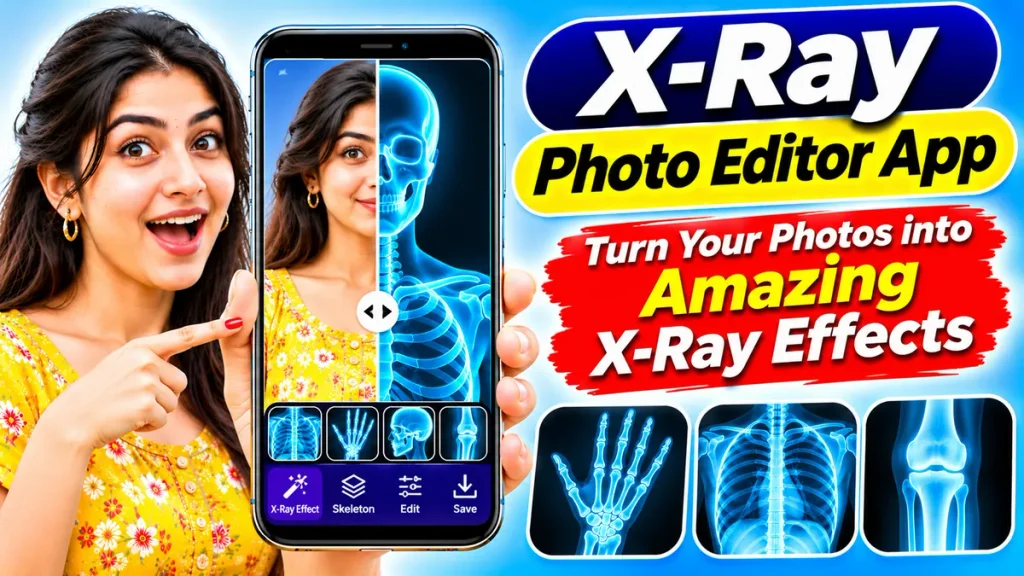
But can these editing applications actually reveal what is hidden beneath human skin? This complete guide explains X-Ray Photo Editor Apps, Android features, photo editing techniques, AI-generated skeleton effects, installation procedures, privacy considerations, and the difference between simulated X-ray images and genuine medical scans.
What Is an X-Ray Photo Editor App?
An X-Ray Photo Editor App is a mobile photo-editing application designed to create images resembling X-ray photographs through digital filters and visual effects.
These applications may transform normal photographs into blue, black, white, or negative-style images.
Some editors also provide skeleton overlays, glowing outlines, transparency adjustments, and artificial scanning animations.
Unlike medical imaging equipment, these applications do not capture genuine X-ray photographs.
Their primary purpose is creative editing, entertainment, and visual experimentation.
Can an X-Ray Photo Editor Really See Through Objects?
The answer is no. Ordinary smartphone cameras cannot see through the human body or solid objects using standard photo-editing software.
A mobile camera captures information primarily from visible light reflected by objects.
X-Ray Photo Editor Apps modify the appearance of existing images using software.
Although artificial intelligence may generate convincing illustrations of bones or internal structures, those results are predictions or artistic simulations.
They do not reveal the actual internal anatomy of a person.
Real medical X-rays require specialized equipment designed to generate and detect X-ray radiation.
X-Ray Photo Editor App – Important Information
| Feature | Details |
|---|---|
| Application Category | Photo Editing and Entertainment |
| Common Platform | Android Smartphones |
| Main Function | X-Ray-Style Photo Effects |
| Photo Filters | Available in Selected Apps |
| Skeleton Overlays | Depends on Application |
| AI Image Effects | Available in Some Editors |
| Camera Integration | Depends on Developer |
| Real X-Ray Imaging | Not Supported |
| Medical Diagnosis | Not Suitable |
| Download Cost | Free or Paid |
| Internet Requirement | Depends on Features |
Different applications provide different capabilities, so users should examine their descriptions before installing them.
Popular Features of X-Ray Photo Editor Apps
1. X-Ray-Style Photo Filters
These filters transform ordinary photographs into images resembling traditional radiographic pictures.
They commonly adjust brightness, contrast, colors, and tonal values.
2. Skeleton Overlay Effects
Some applications allow users to place artificial skeleton illustrations over photographs.
These graphics create an entertaining impression of seeing bones beneath the skin.
3. Negative Image Effects
Negative filters reverse or modify image tones, producing unusual photographic appearances.
They can create dramatic black-and-white or blue-tinted results.
4. AI-Powered Image Transformation
Certain AI photo editors generate creative illustrations based on uploaded photographs.
These features may produce skeleton-themed artwork or futuristic scanning effects.
5. Glowing Bone Illustrations
Some editors provide luminous blue or green skeletal graphics.
Users may adjust their positioning, transparency, and brightness.
6. Background and Color Editing
Selected applications include background adjustments, cropping, sharpening, and color correction tools.
These features can improve the overall appearance of edited photographs.
How Does an X-Ray Photo Editor App Work?
Most X-Ray Photo Editor Apps use digital image-processing technology.
When users select a photograph, the application analyzes or modifies its existing visual information.
Basic filters adjust color channels, brightness, contrast, and image tones.
More advanced applications may combine multiple effects, including artificial skeletal graphics and transparent overlays.
AI-powered editors can generate new visual elements based on patterns learned during model training.
However, these generated elements do not represent verified hidden structures.
The completed image is a digital creation rather than a genuine medical X-ray photograph.
How to Download and Use an X-Ray Photo Editor App on Android – Step-by-Step Guide
Follow these general steps to create X-ray-style photographs using a compatible Android application.
Step 1: Open a Trusted App Store
Open the official application marketplace available on your Android smartphone.
Avoid unknown websites distributing modified installation files.
Step 2: Search for X-Ray Photo Editor
Enter relevant search terms such as X-Ray Photo Editor App, X-Ray Photo Effects, or Skeleton Photo Editor.
Review the available applications.
Step 3: Read the Application Description
Check whether the developer clearly identifies the application as an entertainment or editing tool.
Avoid applications promising genuine medical imaging through ordinary smartphone cameras.
Step 4: Review Ratings and Permissions
Examine user feedback, privacy disclosures, and requested permissions.
Be particularly cautious when an application requests unnecessary access to personal information.
Step 5: Install the Selected Application
Choose a suitable editor and complete the installation procedure.
Open the application after installation.
Step 6: Select Your Photograph
Choose an existing image from your gallery or capture a new photograph if the application supports camera access.
Use photographs that you have permission to edit.
Step 7: Choose an X-Ray Effect
Explore the available filters, including grayscale, negative, glowing skeleton, or artificial scanner effects.
Select your preferred style.
Step 8: Adjust the Image
Modify brightness, contrast, color intensity, transparency, and other available settings.
Keep the effect visually balanced.
Step 9: Preview the Edited Photograph
Review the final image before exporting.
If using skeleton overlays, remember that the illustrated bones are not genuine anatomical scans.
Step 10: Save Your Creation
Export your edited photograph in a supported format.
Available output formats and image quality depend on the application.
X-Ray Photo Editor vs Real Medical X-Ray
Understanding the difference between entertainment editing and genuine diagnostic imaging is essential.
| Feature | X-Ray Photo Editor | Medical X-Ray |
|---|---|---|
| Main Purpose | Creative Photo Editing | Medical Examination |
| Technology | Software Filters | Specialized Imaging Equipment |
| Actual Bone Detection | No | Yes |
| Smartphone Compatible | Yes | Requires Medical Equipment |
| Medical Diagnosis | Not Supported | Supports Clinical Diagnosis |
| Image Output | Artificial Visual Effects | Genuine Radiographic Images |
| Professional Interpretation | Not Applicable | Required for Medical Assessment |
An edited photograph should never be treated as a reliable medical examination.
Can AI Create Realistic X-Ray Photo Effects?
Artificial intelligence can produce convincing X-ray-style illustrations using image-generation technology.
AI models may identify visible body outlines, estimate positions, or generate fictional anatomical structures.
These features can make creative editing more interesting.
However, AI cannot determine the actual condition of internal organs or bones from a standard photograph.
Generated images may include anatomical inaccuracies, distorted structures, or unrealistic details.
They should therefore be used for entertainment or illustration rather than healthcare decisions.
Are X-Ray Photo Editor Apps Safe?
Most ordinary photo-editing applications do not produce medical X-ray radiation.
However, privacy and security remain important considerations.
Some editors process uploaded photographs through remote servers, while others operate directly on the device.
Review application permissions, privacy practices, subscription conditions, and data-handling policies before using an unfamiliar service.
Avoid uploading sensitive personal images unnecessarily.
Never depend on edited photographs to identify fractures, injuries, or other medical conditions.
Common Mistakes When Using X-Ray Photo Editors
One common mistake is assuming that a realistic-looking skeleton effect represents actual bones.
Another is installing applications from untrusted sources without reviewing their permissions.
Some users also overlook subscription terms or grant unnecessary access to private photographs.
Selecting reputable applications, understanding their limitations, and protecting personal information can make the experience safer.
Frequently Asked Questions (FAQ)
1. Can an X-Ray Photo Editor App reveal actual bones?
No. These applications create artificial visual effects and cannot reveal genuine bones using ordinary smartphone photographs.
2. Are X-Ray Photo Editor Apps available for Android?
Yes. Android users can find photo-editing applications offering X-ray-style filters, negative effects, and skeleton illustrations.
3. Can I create X-ray-style photos for free?
Some applications offer free editing features, while others include advertisements, subscriptions, or paid effects.
4. Can AI turn normal photos into realistic X-ray images?
AI can create convincing X-ray-style illustrations, but the results are generated effects rather than genuine medical scans.
5. Do X-Ray Photo Editor Apps work offline?
Some editing features work offline, while cloud-based AI tools may require an internet connection.
6. Can these applications detect broken bones?
No. Photo-editing applications cannot reliably diagnose fractures or other internal injuries.
7. Can I save edited X-ray photographs?
Many applications support saving or exporting edited images, although available formats depend on the developer.
Conclusion
An X-Ray Photo Editor App for Android offers an interesting way to transform ordinary photographs into creative X-ray-style images. With digital filters, skeleton overlays, artificial intelligence, and color adjustments, users can experiment with entertaining visual effects directly from their smartphones.
However, these applications cannot perform genuine medical X-ray examinations or reveal actual internal body structures. Their outputs are digital simulations intended for creative purposes.
Before downloading an X-Ray Photo Editor, review its features, permissions, privacy practices, and developer information. Enjoy the creative possibilities while understanding the difference between artificial photo effects and real medical imaging.